
Free for teachers · 328 simulations · 6 languages
Interactive simulations for science and math
Run them in class, share a link with your students, or embed them in your website or LMS. Students never need an account.
Search results
- Mathematics · Vectors & Coordinate Geometry Conic sections by eccentricity With the same focus and directrix, only the eccentricity e changes: e < 1 gives an ellipse, e = 1 a parabola, e > 1 a hyperbola. The... Ages 15–16
- Mathematics · 3D Geometry Orthographic projection – three views of a solid Build a solid from unit cubes (click the grid to raise or lower each column) or pick a preset shape, rotate it to look around, and see... Ages 16–17
- Mathematics · Statistics Grouped frequency table and relative frequency chart A data sample (student height, weight, or daily self-study time) is grouped into classes of a chosen width. The frequency table n_i,... Ages 14–15
- Mathematics · Plane Geometry Triangle inequality – joining three segments Three segments a, b, c form a triangle if and only if each side is shorter than the sum of the other two. Drag the sliders or drag... Ages 12–13
- Mathematics · Algebra Linear inequality in one variable – solution set on a number line Solve the inequality ax + b > c (or <, ≥, ≤) step by step: transpose terms, then divide both sides by a and flip the sign when a < 0.... Ages 14–15
- Mathematics · Probability Discrete random variables – expectation as the long-run average Build the probability distribution table of a discrete random variable in a real-world scenario (a dice game with a prize, the number of... Ages 17–18
- Mathematics · Statistics Data charts – bar, line, and pie from the same table A single data table (monthly temperatures, top students per class, quarterly revenue…) is drawn as a bar chart, a line graph, or a pie... Ages 12–13
- Mathematics · Statistics Choosing chart types – misleading graphs The same dataset is drawn as a bar chart, grouped bar chart, line graph, and pie chart. Students switch chart types, drag the top of a... Ages 13–14
- Mathematics · Sets, Logic & Graph Theory Venn Diagrams – Set Operations Two or three sets A, B, C are drawn as a Venn diagram inside the universal set U = {1; 2; …; N}, with every element placed in its exact... Ages 15–16
- Mathematics · Numbers & Arithmetic Square Roots and Cube Roots – Side of a Square and a Cube A square with area S has side √S; a cube with volume V has side ∛V. Drag the square's corner or the cube's vertex to change S and V and... Ages 14–15
- Mathematics · Numbers & Arithmetic Square Roots on the Number Line – Construction and Approximation Construct √2 as the diagonal of a unit square, then chain right triangles with leg 1 to build √3, √4, … √n (the Theodorus spiral), and... Ages 12–13
- Mathematics · Sequences & Financial Math Arithmetic and geometric sequences – simple and compound interest Graph of the terms u₁…uₙ of an arithmetic sequence (points in a straight line) or a geometric sequence (points on an exponential curve).... Ages 16–17
- Mathematics · Algebra Grade 10 Math Topics – Linear Systems, Induction & Binomial Theorem, Conic Sections Three Grade 10 elective topics in one simulation, chosen with the topic parameter. System of three linear equations: step through... Ages 15–16
- Mathematics · Sets, Logic & Graph Theory Grade 11 electives – transformations, graphs, and technical drawing Three Grade 11 elective topics in one template, switched with the topic parameter. Transformations: drag the triangle's three vertices... Ages 16–17
- Mathematics · Sequences & Financial Math Grade 12 Math Topics – Discrete Random Variables, Financial Math, Optimization Three Grade 12 elective topics in one simulation, chosen with the topic parameter. Discrete random variable: toss n coins thousands of... Ages 17–18
- Mathematics · Vectors & Coordinate Geometry Conic sections – the reflective property (satellite dish, whispering gallery, telescope) Rays of light hit a mirror shaped like a conic section and you watch where they go after reflecting: rays parallel to the axis of a... Ages 15–16
- Mathematics · Algebra Polynomials in one variable – graphs, values and roots Choose the degree and the coefficients of a polynomial P(x) of degree 1, 2 or 3; the simulation writes the polynomial in standard form,... Ages 12–13
- Mathematics · Algebra Sign of a quadratic function Drag a, b and c to change the parabola y = ax² + bx + c and read the matching sign table right away. The simulation shades the part of... Ages 15–16
- Mathematics · Calculus Area between two curves Pick a pair of curves and watch the plane region between them get shaded. The simulation splits the region into thin strips to show that... Ages 17–18
- Mathematics · Plane Geometry Law of Cosines, Law of Sines, and triangle area Triangle ABC is built from two sides a, b and the included angle C; drag any of the three vertices freely. Every side and angle updates... Ages 15–16
- Mathematics · Statistics Variance, standard deviation, and IQR of grouped data Two samples with the same mean but different spread are grouped and plotted overlapping each other. Drag each sample's σ slider to watch... Ages 17–18
- Mathematics · Algebra The fraction (ax + b)/(cx + d): domain and graph Graphs the value of the rational expression y = (ax + b)/(cx + d) as x varies. Students drag the sliders a, b, c, d and drag point P... Ages 13–14
- Mathematics · Plane Geometry Constructing triangles with a compass – congruence criteria Construct triangle ABC step by step as if using a ruler and compass: the SSS case (three sides), the SAS case (two sides and the... Ages 12–13
- Mathematics · Sets, Logic & Graph Theory Weighted graphs and shortest path – Dijkstra's algorithm A map of locations is modeled as a graph: vertices are places, edges are roads, and weights are distances in kilometers. Choose a start... Ages 16–17
- Mathematics · Vectors & Coordinate Geometry Lines and circles in the coordinate plane Line Δ: ax + by + c = 0 has normal vector n = (a; b) and direction vector u = (−b; a) drawn right on the figure; circle (C) has center I... Ages 15–16
- Mathematics · Functions & Graphs Rational functions – asymptotes of the graph For y = (ax + b)/(cx + d) or y = (ax² + bx + c)/(x + d), drag the coefficients to see the vertical, horizontal and oblique asymptotes... Ages 17–18
- Mathematics · Plane Geometry Circles – chords and tangents Circle (O; R) with a chord AB and an external point M. Drag the chord's midpoint H to change the distance OH and see that OH ⟂ AB and AB... Ages 14–15
- Mathematics · Trigonometry Unit circle and the sine, cosine, tangent graphs Drag point M on the unit circle and the matching point moves in sync on the graph of y = sin x, cos x or tan x. The line y = m crossing... Ages 16–17
- Mathematics · Statistics Mean, median and mode of grouped data Generate a sample of test scores out of 100 and group them into a frequency chart. Change the class width or the distribution shape, and... Ages 16–17
- Mathematics · Functions & Graphs Limits of Sequences and Functions, Continuity Sequence mode: the points (n, uₙ) approach the line y = L; a draggable band L ± ε shows that from some index N₀ onward every term stays... Ages 16–17
- Mathematics · 3D Geometry Angle Between a Line and a Plane, Distance in a Regular Pyramid A regular pyramid S.ABCD (or S.ABC) can be rotated with the mouse or a finger. The simulation constructs the projection of the lateral... Ages 16–17
- Mathematics · Plane Geometry Parallel Lines and a Transversal – Alternate and Corresponding Angles Two lines a and b are cut by a transversal line c at points A and B, forming 8 angles. Drag the end of line b to tilt it or make it... Ages 12–13
- Mathematics · Plane Geometry Angles – protractor and midpoint Two rays Ox and Oy pivot around vertex O to form angle xOy; a semicircular protractor lines up with ray Ox so you can read the measure.... Ages 11–12
- Mathematics · Probability Rolling two dice – sample space and probability The sample space for rolling two dice has 36 equally likely outcomes, arranged in a 6×6 table. Choose an event (sum equals k, sum at... Ages 14–15
- Mathematics · Functions & Graphs Exponential function y = aˣ and logarithmic function y = logₐx The graphs of y = aˣ and y = logₐx are reflections of each other across the line y = x. Drag point M on the exponential graph and its... Ages 16–17
- Mathematics · Functions & Graphs Linear functions – graphs and the equation ax + b = 0 Graph of y = ax + b on the coordinate plane. Drag the point on the y-axis to change b, drag the second point to change the slope a, and... Ages 13–14
- Mathematics · Functions & Graphs Continuity of a function at a point A piecewise function joined at x₀, with an adjustable parameter m. The simulation computes the left-hand limit, the right-hand limit and... Ages 16–17
- Mathematics · Algebra Algebraic Identities – Cut and Rearrange Illustrates (a + b)², (a − b)² and a² − b² using the areas of squares and rectangles. Students drag the handles to change a and b, then... Ages 13–14
- Mathematics · Algebra Systems of Three Linear Equations – Planes and Gaussian Elimination Each equation ax + by + cz = d is a plane in space. Rotate the 3D frame to see three planes meet at one point (unique solution), meet... Ages 15–16
- Mathematics · Algebra Systems of Two Linear Equations – Solving Graphically Two lines a₁x + b₁y = c₁ and a₂x + b₂y = c₂ are drawn on the coordinate plane; their intersection is the solution of the system.... Ages 14–15
- Mathematics · 3D Geometry Regular pyramids – triangular and square base A regular pyramid is drawn in 3D; drag it to rotate in any direction, or switch on auto-rotate. Change the base edge, the height, and... Ages 13–14
- Mathematics · Plane Geometry Lines of symmetry and point symmetry Choose a square, rectangle, rhombus, regular hexagon, or any quadrilateral, and the simulation finds and draws every line of symmetry... Ages 11–12
- Mathematics · 3D Geometry Cuboids and triangular prisms in 3D A cuboid (a × b × h) or a right prism whose base is a right triangle (legs a, b and height h) is drawn in space; drag to rotate it and... Ages 12–13
- Mathematics · 3D Geometry Cross-section of a cuboid through three points The cuboid ABCD.A'B'C'D' can be rotated by mouse or touch. Three points M on AB, N on AD, and P on CC' can be dragged along their edges;... Ages 16–17
- Mathematics · 3D Geometry Cylinder, cone, and sphere – surface area and volume A 3D model of a cylinder, cone, or sphere that can be rotated by dragging with the mouse or a finger. Drag the radius R and height h... Ages 14–15
- Mathematics · Probability Permutations, arrangements & combinations – choosing k from n items n items labeled A, B, C… sit in a row; students tap to pick k of them, either ordered or unordered, and compare against the full list of... Ages 15–16
- Mathematics · Functions & Graphs Cubic and rational function analysis – derivatives, extrema, asymptotes Plots y = ax³ + bx² + cx + d or y = (ax + b)/(cx + d) alongside a variation table built live from the sign of y'. Drag point M along the... Ages 17–18
- Mathematics · Numbers & Arithmetic Rounding decimals on a number line A decimal number sits on two number lines: the top one is marked off by the rounding place, and the bottom one zooms into the interval... Ages 11–12
- Mathematics · Vectors & Coordinate Geometry Planes and spheres in 3D space – distance from center to plane In a rotatable Oxyz coordinate system, the plane (P): Ax + By + Cz + D = 0 and a sphere with center I and radius R are drawn together... Ages 17–18
- Mathematics · Algebra Solution region of a system of linear inequalities in two variables Draws the solution region of a system of up to 3 inequalities of the form ax + by ≤ c (or ≥, <, >) on the coordinate plane. Students... Ages 15–16
- Mathematics · Plane Geometry Circumscribed and inscribed circles of triangles and regular polygons Drag the three vertices of a triangle: the circumcenter O is the intersection of the three perpendicular bisectors, the incenter I is... Ages 14–15
- Mathematics · Algebra Multiplying polynomials with an area model A rectangle with length a + b and width c + d is split into 4 cells. Students drag the handles on the edges to change a, b, c, d and see... Ages 13–14
- Mathematics · Algebra Binomial theorem, Pascal's triangle, and proof by induction The expansion of (a + b)ⁿ has coefficients equal to row n of Pascal's triangle. Increase n step by step to see how each new row is... Ages 15–16
- Mathematics · Functions & Graphs Quadratic function y = ax² + bx + c: vertex, axis of symmetry, variation table The parabola y = ax² + bx + c is graphed with three sliders for a, b, c right in the simulation; students can also drag the vertex I... Ages 15–16
- Mathematics · Calculus Parabola and the tangent line at a moving point The graph of y = ax² + bx + c has a point M that moves along the parabola. Drag M with the mouse or a finger; the tangent line at M is... Ages 16–17
- Mathematics · Functions & Graphs Parabola y = ax² and quadratic equations The graph of y = ax² together with the line y = bx + c. Drag the point on the parabola to change a (opens up/down, narrow/wide), and... Ages 14–15
- Mathematics · Numbers & Arithmetic Fraction models – comparing and adding Two fractions are shaded on a bar or circle model. Tap the parts to change the numerator and use the buttons to change the denominator.... Ages 11–12
- Mathematics · Vectors & Coordinate Geometry Geometric Transformations and Composition Drag the F-shape and the elements of each transformation (translation vector, center of rotation, line of reflection, center of... Ages 16–17
- Mathematics · Trigonometry Basic Trigonometric Equations on the Unit Circle Solve sin x = m, cos x = m, or tan x = m using the unit circle: the simulation marks the terminal points that satisfy the equation,... Ages 16–17
- Mathematics · Probability Addition and Multiplication Rules of Probability with Venn and Tree Diagrams A Venn diagram with areas proportional to probability: drag event B closer to or farther from A to change P(AB), and instantly see P(A ∪... Ages 16–17
- Mathematics · Numbers & Arithmetic Sieve of Eratosthenes – finding prime numbers A grid of numbers from 1 to N. Each time you click 'Next step', the smallest unmarked prime is highlighted in blue and its multiples are... Ages 11–12
- Mathematics · Statistics Summary statistics of a data set – dragging data points A data sample is shown as a dot plot on a number line. Drag any point (or click 'Random') and watch the mean, median, quartiles Q₁, Q₂,... Ages 15–16
- Mathematics · Plane Geometry Similar triangles – measuring height with shadows Two similar triangles ABC and A'B'C' with ratio k: drag the vertices of ABC to reshape it, or drag B' or C' to change the ratio and... Ages 13–14
- Mathematics · Plane Geometry Thales' theorem – parallel lines in a triangle Triangle ABC with a line DE crossing sides AB and AC. Drag D along AB (E follows so that DE ∥ BC) to see the ratios AD/DB = AE/EC and... Ages 13–14
- Mathematics · Algebra Direct and inverse proportion – table and graph A table of values and the graph of y = kx (direct proportion) or y = k/x (inverse proportion). Drag the point on the graph horizontally... Ages 12–13
- Mathematics · Trigonometry Trig ratios of an acute angle – measuring height with elevation angle Right triangle ABC, right-angled at A: drag vertex C to change the acute angle B = α, drag B to change the adjacent side; sin, cos, tan... Ages 14–15
- Mathematics · Calculus Integrals as a limit of rectangle areas The area of the curved region below the curve y = f(x) on [a, b] is approximated by n rectangles (left, right, midpoint) or trapezoids.... Ages 17–18
- Mathematics · Calculus Real-world optimization with derivatives Pick a real-world problem – designing a can that uses the least material, folding an open-top box with the largest volume, or setting a... Ages 17–18
- Mathematics · Numbers & Arithmetic Adding and subtracting integers on a number line A number line with two arrows: the blue arrow goes from 0 to a, and the red arrow continues b steps further (to the right for adding a... Ages 11–12
- Mathematics · Numbers & Arithmetic Rational numbers on a number line – comparing and zooming in Two rational numbers a and b (entered as p/q or a decimal) are marked on a number line; the zoomed-in axis below is divided by their... Ages 12–13
- Mathematics · Plane Geometry Quadrilaterals – identifying special shapes Drag the four vertices A, B, C, D on the grid; the simulation measures the sides, angles, and diagonals to identify a trapezoid,... Ages 13–14
- Mathematics · Probability Dice and coin tosses – experimental probability Roll a die or flip a coin many times; each outcome is tallied in a table and a frequency bar chart updates instantly. Students compare... Ages 11–12
- Mathematics · Sequences & Financial Math Amortized loans – declining balance, annuity, and the flat-rate trap Enter the loan amount, annual interest rate, and term in months, then choose a repayment method: equal principal with interest on the... Ages 17–18
- Mathematics · Vectors & Coordinate Geometry Vectors – sum, difference, scalar multiple and dot product Two vectors u, v are drawn from the origin O on a coordinate grid; students drag the tips of u and v (snapped to the grid) and pick an... Ages 15–16
- Mathematics · Vectors & Coordinate Geometry Vectors in 3D space – sum, dot product, angle An Oxyz coordinate system rotates with the mouse or a finger, showing two vectors u and v with given coordinates. The simulation draws... Ages 17–18
- Mathematics · Probability Spinning wheel and bag of marbles – events and probability A spinning wheel is divided into colored slices of different widths (or a bag holds a matching number of marbles per color). Spin once... Ages 12–13
- Mathematics · Probability Classical probability: sample space and events List out the entire sample space Ω when tossing 2–3 coins or rolling 1–2 dice (shown as a 6 × 6 grid with dice faces drawn as pips).... Ages 15–16
- Mathematics · Probability Conditional probability and Bayes' theorem: disease testing A medical-testing problem: disease prevalence, sensitivity P(+|disease), and specificity P(−|healthy) are given. A tree diagram, a 2×2... Ages 17–18
- Mathematics · Probability Experimental probability from repeated marble draws A bag holds red, blue, and yellow marbles; draw one at random, record its color, put it back, and repeat N times. Students draw one... Ages 13–14
- Physics · Energy & Momentum Conservation of mechanical energy – object sliding on a curved track An object of mass m is released from height h, slides down a curved track, and climbs up the other side. Bars for kinetic energy Ek,... Ages 15–16
- Physics · Physics & the Environment The greenhouse effect and Earth's energy balance Whether Earth warms or cools depends on the balance between the solar energy it absorbs and the infrared radiation it emits. Adjust the... Ages 15–16
- Physics · Thermal Physics & Gases Thermal equilibrium – dropping a hot object into water Object 1 (metal, water, or ice at 0 °C) with mass m₁ at temperature T₁ is dropped into water of mass m₂ at T₂ inside a calorimeter. Heat... Ages 17–18
- Physics · Physics & the Environment Physics 10 electives – physics at work, Earth and sky, physics and the environment Three Physics 10 elective topics in one simulation, switchable with the topic parameter. Physics at work: a lifting machine from... Ages 15–16
- Physics · Electricity & Circuits Physics 11 Electives – gravitational field, radio waves, electronics Three Physics 11 elective topics in one template, switched with the topic parameter. Gravitational field: drag to change a satellite's... Ages 16–17
- Physics · Quantum & Nuclear Physics Physics 12 topics – AC circuits, medical imaging, quantum physics Three Grade 12 physics topics in one simulation, chosen with the topic parameter. Alternating current: a series R, L, C circuit with... Ages 17–18
- Physics · Oscillations & Waves Spring pendulum – simple harmonic motion A mass m attached to a spring of stiffness k is pulled out to amplitude A and released. Watch the mass oscillate and the displacement... Ages 16–17
- Physics · Electric & Magnetic Fields Electric field – two point charges Two point charges q₁ and q₂ sit a distance d apart. Watch the electric field lines, the Coulomb force F = k|q₁q₂|/r² between the... Ages 16–17
- Physics · Oscillations & Waves Radio wave modulation – AM and FM An audio-frequency signal cannot travel far on its own, so it must be carried by a high-frequency carrier wave. Adjust the signal... Ages 16–17
- Physics · Thermal Physics & Gases Boyle's law – isothermal gas compression Pull or push a piston in a sealed cylinder at constant temperature. The measured pressure always satisfies p·V = constant; the p–V graph... Ages 17–18
- Physics · Forces & Dynamics Hooke's law and liquid pressure Left: a spring of stiffness k holds a hanging mass m, stretching by Δl = mg/k; pull the mass down and release it to see it oscillate... Ages 15–16
- Physics · Forces & Dynamics Newton's second law – pulling a block on a surface Pull a block of mass m with force F along a horizontal or inclined surface with friction μ. Watch the force vectors (F, P, N, Fms), the... Ages 15–16
- Physics · Electricity & Circuits Ohm's law for a complete circuit – internal resistance A closed circuit made of a source (EMF E, internal resistance r) and a rheostat R. Drag the slider directly on the circuit diagram to... Ages 16–17
- Physics · Quantum & Nuclear Physics Photoelectric effect and light quanta Shine light of adjustable wavelength on different metals. Electrons are ejected only when the photon energy hf exceeds the work function... Ages 17–18
- Physics · Thermal Physics & Gases Ideal gas – pV = nRT in a cylinder Gas molecules move randomly inside a cylinder fitted with a piston. Drag the piston to change the volume, slide the temperature bar to... Ages 17–18
- Physics · Forces & Dynamics Centripetal force – uniform circular motion on a string A mass m tied to a string of length R moves in uniform circular motion with angular speed ω (viewed from above). The velocity vector is... Ages 15–16
- Physics · Electric & Magnetic Fields Magnetic force on a current and on charged particles Wire mode: a wire segment of length l carrying current I sits in a uniform magnetic field B at angle α; the magnetic force F = BIl·sinα... Ages 17–18
- Physics · Electricity & Circuits Diode Rectifier Circuit A diode conducts in only one direction, turning an alternating voltage into a bumpy direct voltage. Compare half-wave rectification with... Ages 16–17
- Physics · Electricity & Circuits Series RLC Circuit and Resonance A series R, L, C circuit driven by an AC voltage: graphs of u and i show their phase difference, alongside a phasor diagram and a curve... Ages 17–18
- Physics · Energy & Momentum Lifting Machines on the Job – Work, Power, Efficiency A construction-site crane, a farm hoist, or a passenger lift raises a load to height h. Adjust the mass, height, lifting speed, and... Ages 15–16
- Physics · Kinematics Projectile Motion at an Angle Launch an object with initial speed v0 at angle α to the horizontal, under gravitational acceleration g. Watch the trajectory, the range... Ages 15–16
- Physics · Thermal Physics & Gases Specific heat capacity – heating different materials The same heat source of power P heats two different materials. Since the heat transferred is Q = m·c·Δt, a material with a large... Ages 17–18
- Physics · Electricity & Circuits Ohm's Law – Two Resistors in Series A source U with two resistors R1 and R2 connected in series. The ammeter reads I = U/(R1+R2); the electrons move faster or slower... Ages 14–15
- Physics · Quantum & Nuclear Physics Radioactive decay – decay law and half-life N₀ parent nuclei (red) decay randomly into daughter nuclei (grey), each with the same decay probability per unit time. The graph plots... Ages 17–18
- Physics · Kinematics Free fall and fall with air resistance Two objects of different mass and cross-section are dropped together from the same height. With drag off, both hit the ground at the... Ages 15–16
- Physics · Measurement & Uncertainty Measurement error in repeated length readings A ruler with an adjustable resolution measures a metal rod repeatedly; each reading appears half a second apart with a zoomed-in view of... Ages 15–16
- Physics · Oscillations & Waves Standing waves on a string A string of length l has either both ends fixed or one end free. Change the vibrator frequency and wave speed to find the frequencies... Ages 16–17
- Physics · Quantum & Nuclear Physics X-rays in Medical Diagnosis – Tissue Absorption An X-ray beam passes through different tissue layers: soft tissue absorbs little, bone absorbs much more, giving the image on the film... Ages 17–18
- Physics · Gravitation & Astronomy Earth and the sky – solar altitude by latitude and season Earth's axis is tilted 23.5°, so the Sun's noon altitude and the length of day change with latitude and with the day of the year. Choose... Ages 15–16
- Physics · Gravitation & Astronomy Gravitational field and satellite orbits Change the orbital radius of a satellite around Earth to see how the gravitational field strength g = GM/r², orbital speed and period... Ages 16–17
- Physics · Energy & Momentum Air track collisions – conservation of momentum Two carts of mass m₁ and m₂ move with velocities v₁ and v₂ on an air track, then collide either elastically or inelastically (sticking... Ages 15–16
- Chemistry · Organic Chemistry Alcohol classification and the reactions of alcohols and phenol Choose ethanol (primary), propan-2-ol (secondary), 2-methylpropan-2-ol (tertiary) or phenol: the simulation draws the structural... Ages 16–17
- Chemistry · Biomolecules & Polymers Amino acids: ionic forms with pH, isoelectric point and peptide bonds In ion mode, drag the pH slider from 0 to 14 and watch the amino acid's structure change instantly — a cation in acid, a zwitterion near... Ages 17–18
- Chemistry · Electrochemistry Electrochemical corrosion of metals (Fe–Cu, Fe–Zn, Fe–Sn) and sacrificial protection An iron bar is placed in contact with another metal in NaCl solution, distilled water, dilute acid or dry air: the metal with the lower... Ages 17–18
- Chemistry · Atomic Structure & Periodic Table Periodic table structure – cells, periods and groups An interactive periodic table: click a cell to see its atomic number, electron configuration, period and group, and its s/p/d block.... Ages 15–16
- Chemistry · Kinetics & Equilibrium Chemical equilibrium – N₂O₄ ⇌ 2NO₂ shift A sealed flask holds the equilibrium N₂O₄ (colorless) ⇌ 2NO₂ (reddish-brown). Change the temperature or compress/expand the flask, then... Ages 16–17
- Chemistry · Reactions & Redox Balancing redox equations – the electron balance method Step by step: assign oxidation numbers to each element, find which ones gain or lose electrons, write the oxidation and reduction... Ages 15–16
- Chemistry · Biomolecules & Polymers Carbohydrates: structure, hydrolysis and identification reactions Choose glucose, fructose, sucrose, starch or cellulose, and the simulation draws the matching number of linked rings (one ring, two... Ages 17–18
- Chemistry · Atomic Structure & Periodic Table Electron Configuration – Atoms Z = 1–36 Pick an element on the mini periodic table and watch its electrons fill the shells (Bohr model) and orbital boxes according to the... Ages 15–16
- Chemistry · Acids, Bases & Titration Acid–Base Titration and the Titration Curve Add NaOH solution drop by drop from a burette into the acid in an Erlenmeyer flask. The pH-vs-volume graph updates with every drop,... Ages 17–18
- Chemistry · Organic Chemistry Fractional distillation of crude oil Crude oil is heated and fed into a fractionating tower: short-chain hydrocarbons with low boiling points rise to the top, while... Ages 16–17
- Chemistry · Applied & Practical Chemistry Chemistry 10 Special Topics – thermodynamics, fire safety, computing Three Chemistry 10 special topics in one sim, selected with the topic parameter. Chemical thermodynamics: change the temperature to see... Ages 15–16
- Chemistry · Applied & Practical Chemistry Chemistry 11 Special Topics – fertilizers, esterification, petroleum Three Chemistry 11 special topics in one sim, selected with the topic parameter. Fertilizers: choose a fertilizer type and the amount... Ages 16–17
- Chemistry · Applied & Practical Chemistry Grade 12 Chemistry – Reaction Mechanisms, Titration & Complex Ions Three Grade 12 chemistry topics in one model, selected with the topic parameter. The reaction mechanisms tab animates the SN2 and SN1... Ages 17–18
- Chemistry · Organic Chemistry SN1 and SN2 Nucleophilic Substitution Mechanisms Substitution reactions of halogenoalkanes can follow two pathways: the one-step SN2, where the nucleophile attacks from behind as the... Ages 17–18
- Chemistry · Electrochemistry Electrolysis of Aqueous Solutions with Inert Electrodes Electrolyse an aqueous solution of CuSO₄, NaCl or Na₂SO₄ using graphite electrodes. The simulation shows which species is actually... Ages 17–18
- Chemistry · Organic Chemistry Preparing Banana Oil (Isoamyl Acetate) – Rate, Catalyst and Yield Heat acetic acid with isoamyl alcohol to prepare banana oil, tracking how much ester forms minute by minute. Toggle concentrated H₂SO₄... Ages 16–17
- Chemistry · Organic Chemistry Reversible Esterification and the Silver Mirror Test Esterification mode: a carboxylic acid and an alcohol meet in a test tube with concentrated H₂SO₄ as catalyst; ester and water molecules... Ages 16–17
- Chemistry · Energetics & Thermodynamics Reaction energy diagram – exothermic vs endothermic An enthalpy diagram plots the reaction path: reactants climb over the activation-energy barrier Ea, then drop to the product level... Ages 15–16
- Chemistry · Inorganic Chemistry Group 17 halogens – color, state and oxidizing power Pick F₂, Cl₂, Br₂ or I₂ and drag the temperature slider: the vessel shows the element's real color and physical state at that... Ages 15–16
- Chemistry · Inorganic Chemistry Complex ion formation constants – stepwise ligand binding A ligand does not replace all the water molecules at once; it attaches to the metal ion one step at a time, each step with its own... Ages 17–18
- Chemistry · Organic Chemistry 3D Hydrocarbon Models – Alkanes, Alkenes, Alkynes, Benzene, and Br₂ Addition Ball-and-stick (or space-filling) models of methane, ethane, propane, butane, 2-methylpropane, ethylene, propene, acetylene, and benzene... Ages 16–17
- Chemistry · Inorganic Chemistry Group 1/2 flame colors and water hardness treatment Flame test mode: hold a salt sample of Li, Na, K, Ca, Sr or Ba in the burner flame, watch the flame turn the characteristic color, and... Ages 17–18
- Chemistry · Chemical Bonding Ionic vs covalent bonding – atomic models (NaCl, MgO, Cl₂, HCl, H₂O, CO₂, N₂) Two atoms approach each other: a metal fully transfers an electron to a nonmetal, forming oppositely charged ions that attract (ionic... Ages 15–16
- Chemistry · Energetics & Thermodynamics Gibbs free energy – when a reaction turns spontaneous Whether a reaction proceeds spontaneously is decided by the sign of ΔG = ΔH − TΔS. Pick a reaction (limestone calcination, NH₃... Ages 15–16
- Chemistry · Inorganic Chemistry Halide ions – identification with AgNO₃ Add AgNO₃ solution to samples of NaF, NaCl, NaBr and NaI. The simulation shows the correct precipitate colour for each (white AgCl, pale... Ages 15–16
- Chemistry · Applied & Practical Chemistry Fertilizer – dose, yield and nutrient loss Choose a fertilizer (urea, ammonium nitrate, superphosphate, KCl) and a dose per hectare. The simulation converts it to the actual... Ages 16–17
- Chemistry · Reactions & Redox 2H₂ + O₂ → 2H₂O – sparking a hydrogen explosion A mixture of H₂ and O₂ gas in a flask does not react at room temperature. Click Ignite (or tap the flask): the spark supplies energy,... Ages 13–14
- Chemistry · Inorganic Chemistry Transition Metal Complexes – Color, Coordination Number, and Geometry A beaker holds the aqua complex of a transition metal ion (Cu²⁺, Co²⁺, Ni²⁺, Fe³⁺, Cr³⁺) in its real color. Drag the... Ages 17–18
- Chemistry · Electrochemistry Galvanic cells and electrolysis – standard electrode potentials Galvanic cell mode: two metal electrodes sit in solutions of their own salts, joined by a wire and a salt bridge; electrons flow through... Ages 17–18
- Chemistry · Organic Chemistry Organic compound separation – distillation, extraction, and TLC Three familiar techniques in a single simulation. Distillation: heat a liquid mixture and the thermometer holds steady at the boiling... Ages 16–17
- Chemistry · Applied & Practical Chemistry Fire safety – the fire triangle and explosive limits A fire only sustains itself when three elements are all present: fuel, oxygen and heat. Choose a gas (methane, LPG, hydrogen), then... Ages 15–16
- Chemistry · Kinetics & Equilibrium Reaction rate – collision model (concentration, temperature, catalyst, surface area) Gas particle A collides with solid B (block or powder); only collisions with enough activation energy form product C. The graph of C... Ages 15–16
- Chemistry · Kinetics & Equilibrium Haber–Bosch ammonia synthesis: N₂ + 3H₂ ⇌ 2NH₃ A reaction vessel holds N₂ and H₂ molecules; once running, they collide and gradually convert to NH₃ until equilibrium is reached. Drag... Ages 16–17
- Chemistry · Biomolecules & Polymers Addition polymerisation: monomers joining into a polymer chain (PE, PP, PVC, PTFE, PS) Monomer molecules with a C=C double bond (ethylene, propylene, vinyl chloride, tetrafluoroethylene, styrene) move freely; as... Ages 17–18
- Chemistry · Biomolecules & Polymers Fat saponification and how soap micelles clean Saponification mode: a fat molecule (a glycerol backbone plus three fatty-acid residues) is cut by OH⁻ ions at its three ester bonds,... Ages 17–18
- Chemistry · Atomic Structure & Periodic Table Periodic trends (atomic radius, electronegativity, ionisation energy) The first 36 elements of the periodic table are shaded or sized by atomic radius, Pauling electronegativity, first ionisation energy, or... Ages 15–16
- Chemistry · Applied & Practical Chemistry Sensor data logging – graphing, smoothing, and calculating ΔH A temperature sensor records a salt dissolving in water over time. Adjust the mass of salt, the sampling rate, and the sensor noise to... Ages 15–16
- Biology · Human & Animal Physiology Homeostasis – blood glucose and body temperature Eat a meal and watch blood glucose change minute by minute. In a healthy person, glucose entering the blood raises the level, pancreatic... Ages 16–17
- Biology · Cell Biology Levels of biological organization Zoom continuously from molecules up to the biosphere: molecule, organelle, cell, tissue, organ, organ system, organism, population,... Ages 15–16
- Biology · Evolution Natural selection – changing allele frequency (peppered moth) A moth population rests on tree trunks: genotypes AA and Aa give dark wings, aa gives light wings, and each genotype has its own fitness... Ages 17–18
- Biology · Human & Animal Physiology Human ovulation cycle and plant double fertilization A 28-day cycle clock runs through in about ten seconds: four curves for FSH, LH, estrogen, and progesterone change day by day, and the... Ages 16–17
- Biology · Cell Biology Cell cycle and mitosis The cell cycle ring runs G1 → S → G2 → M with a phase hand, three checkpoints, and a DNA-content graph; alongside it, an animated cell... Ages 15–16
- Biology · Microbiology & Viruses Viral replication – lytic and lysogenic cycles A phage attaches to a bacterium and injects its DNA, the host cell synthesizes viral DNA and coat protein, assembles dozens of new... Ages 15–16
- Biology · Biotechnology Biology 10 electives – cell, enzyme, and microbial technologies Three Biology 10 elective topics in one simulation, selected with the topic parameter. Cell technology: plant tissue culture, where... Ages 15–16
- Biology · Health & Disease Biology 11 electives – mineral nutrition, human epidemics, and food safety Three Biology 11 elective topics in one simulation, selected with the topic parameter. Mineral nutrition: choose the deficient element... Ages 16–17
- Biology · Ecology & Environment Biology 12 electives – molecular biology, biological control, and human ecology Three Biology 12 elective topics in one simulation, selected with the topic parameter. Molecular biology: run a PCR reaction through the... Ages 17–18
- Biology · Health & Disease Disease spread and herd immunity (SIR model) The SIR model divides a community into susceptible, infected, and recovered groups. Choose a disease (seasonal flu, COVID-19, measles)... Ages 16–17
- Biology · Human & Animal Physiology Neuron resting and action potential A cross-section of the neuron membrane shows Na⁺ and K⁺ ions on both sides, Na⁺ channels, K⁺ channels and the Na⁺/K⁺ pump; click... Ages 16–17
- Biology · Genetics Gene mutation and its effect on the polypeptide Edit one nucleotide on the template strand: substitution, insertion or deletion. The simulation re-runs transcription–translation and... Ages 17–18
- Biology · Biotechnology Industrial enzymes – Michaelis–Menten kinetics and immobilized enzymes Pick a real-world application – lactase for lactose-free milk, pectinase for clarifying fruit juice, protease in biological detergent –... Ages 15–16
- Biology · Cell Biology Enzyme activity vs. temperature, pH, substrate concentration and inhibitors The enzyme (with an active site) and substrate molecules move around and collide; when a substrate molecule fits the active site it is... Ages 15–16
- Biology · Cell Biology Meiosis and the origin of gamete variation Step through each phase of meiosis I and II in a cell with n pairs of homologous chromosomes. Toggle crossing over and watch the number... Ages 15–16
- Biology · Genetics Hardy–Weinberg equilibrium, selection and genetic drift A randomly mating population with two alleles A and a: genotype frequencies p², 2pq and q² are calculated and plotted every generation... Ages 17–18
- Biology · Genetics Gene linkage – crossing over and genetic mapping Two genes sit on the same chromosome: drag the distance between them to change the recombination frequency and watch the ratio of the... Ages 17–18
- Biology · Plant Physiology Plant growth hormones and insect metamorphosis In plant mode, treat a seedling with a hormone at a concentration you drag along the scale: at low concentrations auxin stretches the... Ages 16–17
- Biology · Cell Biology Diffusion across membranes and osmosis in cells On the left, small molecules diffuse through membrane pores from high to low concentration until equilibrium, with particle counts on... Ages 15–16
- Biology · Ecology & Environment Biological pest control – natural enemies versus chemical pesticides Simulate one rice-growing season with a brown planthopper population and its natural enemies (mirid bugs, spiders). Choose a strategy:... Ages 17–18
- Biology · Genetics Dihybrid cross: independent assortment, gene linkage and crossing over A two-gene Punnett square shows each parent's gametes and their frequencies, cells colour-coded by phenotype, and genotype–phenotype... Ages 17–18
- Biology · Microbiology & Viruses Fermentation – lactic acid and ethanol pathways Incubate a batch culture with microorganisms: choose the strain, temperature, initial sugar level and whether oxygen is present. The... Ages 15–16
- Biology · Cell Biology Water and macromolecules – polarity and hydrogen bonding The water mode draws polar H₂O molecules with an oxygen end carrying a partial negative charge and two hydrogen ends carrying a partial... Ages 15–16
- Biology · Biotechnology Plant tissue culture – micropropagation A leaf tissue explant is cultured on a medium containing auxin and cytokinin. Drag the two hormone concentrations to see how the... Ages 15–16
- Biology · Biotechnology PCR – amplifying DNA by thermal cycling Each PCR cycle consists of denaturation at 95 °C, primer annealing, and extension at 72 °C, doubling the number of copies of the target... Ages 17–18
- Biology · Genetics Transcription, translation and point mutations From a gene's template strand, RNA polymerase builds mRNA one nucleotide at a time by base-pairing (A–U, T–A, G–C, C–G); the ribosome... Ages 17–18
- Biology · Plant Physiology Photosynthesis rate – light, CO₂, temperature and the compensation point A sprig of aquatic pondweed (Hydrilla) in a beaker of water under a lamp releases O₂ bubbles faster or slower depending on light... Ages 16–17
- Biology · Microbiology & Viruses Bacterial population growth curve A bacterial population in a culture flask grows following N = N₀·2^(t/g); a graph of log N against time plots itself and colours the... Ages 15–16
- Biology · Cell Biology Eukaryotic and prokaryotic cell structure Diagrams of an animal cell, a plant cell and a bacterium with organelles drawn in their correct positions. Students click each organelle... Ages 15–16
- Biology · Ecology & Environment Food chains, energy pyramids and the carbon cycle Solar energy fixed by producers is passed along a food chain through successive trophic levels; at each level most energy is lost as... Ages 17–18
- Biology · Plant Physiology Transpiration and stomatal control Adjust light, air humidity, wind and soil moisture, then watch the stomata open or close, the transpiration rate change, and water flow... Ages 16–17
- Biology · Plant Physiology Hydroponic vegetables – mineral nutrition and the law of the minimum Mix a nutrient solution for hydroponic vegetables by adjusting N, P, K concentrations and pH. The plant shows the exact deficiency... Ages 16–17
- Biology · Human & Animal Physiology Single and double circulation Compare the single circulatory system of fish side by side with the double circulatory system of mammals: blood flows along its real... Ages 16–17
- Biology · Ecology & Environment Predator–prey dynamics – rabbits and foxes The rabbit population grows logistically, dN/dt = rN(1 − N/K), heading toward the environment's carrying capacity K; once foxes are... Ages 17–18
- Biology · Microbiology & Viruses Bacteria in food – the temperature danger zone How long can cooked food sit out before it's unsafe? Pick a bacterium (Salmonella, Staphylococcus aureus, or Bacillus cereus in leftover... Ages 16–17
- Biology · Biotechnology Wastewater treatment by microorganisms – activated sludge tank Wastewater rich in organic matter (high BOD) flows into a tank, where aerobic bacteria feed on the organic matter using oxygen supplied... Ages 15–16
- Integrated Science · Chemical Reactions Acids, bases and indicators – titration drop by drop A beaker holds an acid or base solution with an indicator already added (litmus, phenolphthalein, or universal pH paper). Students add... Ages 13–14
- Integrated Science · Matter & Materials States of matter – particle model on heating and cooling In a solid, particles sit close together and only vibrate; in a liquid they slide past each other; in a gas they move freely. Click Heat... Ages 11–12
- Integrated Science · Energy Conservation of mechanical energy – kinetic and potential energy on a track A ball slides on a bowl-shaped track or a ramp joined to a flat section. Drag the ball to a starting height and release it: the kinetic... Ages 14–15
- Integrated Science · Electricity & Magnetism Electromagnetic induction – magnet and coil, alternating current Move a bar magnet in and out of a coil (by hand or automatically); the galvanometer needle deflects according to the speed and the... Ages 14–15
- Integrated Science · Life Processes Plant tropisms: phototropism, hydrotropism, gravitropism A bean plant grows in a pot: the shoot and root lengthen day by day. Drag the light source (or the water source) left and right and... Ages 12–13
- Integrated Science · Cells & Organisms Levels of organization – from cell to organism Drag the zoom slider (or click each level) to move from cell → tissue → organ → organ system → organism in humans (cardiac muscle cell →... Ages 11–12
- Integrated Science · Genetics & Evolution Natural selection – light and dark peppered moths A moth population made up of light-colored individuals (dd) and dark-colored individuals (DD, Dd) rests on a tree trunk. Each... Ages 14–15
- Integrated Science · Chemical Reactions Limestone kiln – calcination and the carbon cycle Load limestone into the kiln and adjust the kiln temperature: below about 825 °C the reaction barely proceeds, but from 900 °C upward... Ages 14–15
- Integrated Science · Energy Energy transformation – useful energy, waste and conservation Choose a device (incandescent bulb, LED lamp, electric fan, electric kettle, moped, solar panel): energy particles flow from the source... Ages 11–12
- Integrated Science · Chemical Reactions Metal reactivity series – dropping metal into solution Choose a metal from the reactivity (activity) series — K, Na, Ca, Mg, Al, Zn, Fe, Pb, H, Cu, Ag, Au — and a solution: dilute HCl or... Ages 14–15
- Integrated Science · Scientific Skills & Measurement Length and volume measurement – ruler and graduated cylinder Students drag an object along a ruler so one end lines up with the 0 mark, read its length to the ruler's resolution, and see the... Ages 11–12
- Integrated Science · Forces & Motion Two moving cars – distance–time graph (s–t) Car A and car B move along a straight road at different speeds, with car B given a head start. Press Run and the s–t graph for both cars... Ages 12–13
- Integrated Science · Forces & Motion Levers and moment of force – equilibrium about a pivot The lever's pivot can sit at the centre (a seesaw or balance) or at one end (a wheelbarrow). Drag the two forces along the bar to change... Ages 13–14
- Integrated Science · Life Processes Circulatory and respiratory systems – heart rate during activity The four-chambered heart contracts to pump blood through the pulmonary circuit (heart → lungs → heart) and the systemic circuit (heart →... Ages 13–14
- Integrated Science · Cells & Organisms Dichotomous key – classifying organisms with yes/no questions Students pick an organism (from 8 familiar animals or 6 familiar plants) and answer a series of yes/no questions about its features; the... Ages 11–12
- Integrated Science · Light & Sound Refraction, total internal reflection and lenses Top half: a light ray travels from medium n₁ into medium n₂ — drag the light source to change the angle of incidence and watch the angle... Ages 14–15
- Integrated Science · Chemical Reactions Alcoholic and Acetic Fermentation – Esterification A fermentation vessel holds a glucose solution: switch on the yeast and CO₂ bubbles rise as the ethanol level climbs day by day. The... Ages 14–15
- Integrated Science · Atoms, Elements & Bonding Ionic and Covalent Bonding – NaCl, MgO, H₂, O₂, H₂O, CH₄, NH₃ Two (or more) atoms are drawn with their electron shells far apart; drag across the screen or press Run to bring them together. For NaCl... Ages 12–13
- Integrated Science · Forces & Motion Archimedes' Principle – Floating, Sinking and Liquid Pressure Drag a block and drop it into a tank of liquid: it sinks, floats in equilibrium, or rises to the surface depending on its density... Ages 13–14
- Integrated Science · Forces & Motion Pulling an Object with a Force Meter – Weight, Friction and Spring Extension A wooden block on a table is pulled by a spring force meter. Students drag the meter's hook (or the slider) to increase the pulling... Ages 11–12
- Integrated Science · Electricity & Magnetism Simple electric circuit – measuring current and voltage A circuit with a battery, a switch, light bulbs, an ammeter wired in series and a voltmeter wired in parallel with a bulb. Flip the... Ages 13–14
- Integrated Science · Chemical Reactions Alkane and alkene molecules – 3D ball-and-stick models Ball-and-stick models of methane CH₄, ethane C₂H₆, propane C₃H₈ and ethylene C₂H₄ spin freely in space; drag to rotate them by hand. The... Ages 14–15
- Integrated Science · Atoms, Elements & Bonding Bohr atomic model and mini periodic table (Z = 1–20) Pick the atomic number Z with the ± buttons or by tapping a cell in the mini periodic table. The simulation draws a nucleus of protons... Ages 12–13
- Integrated Science · Energy Small power grid – solar, wind and coal power A 24-hour day plays out in about 10 seconds. The stacked area chart shows output from solar panels (daytime only), wind turbines and... Ages 14–15
- Integrated Science · Earth & Space Day and night, and the phases of the Moon Viewed from above the North Pole: the Sun lights up half of Earth, Earth's spin creates day and night for the observer (red dot), and... Ages 11–12
- Integrated Science · Genetics & Evolution Mitosis and Meiosis – Animated Stages of Cell Division A cell with a diploid chromosome number (2n = 4, 6, or 8) moves through the stages of mitosis (interphase, prophase, metaphase,... Ages 14–15
- Integrated Science · Genetics & Evolution Three-Generation Pedigree and ABO Blood Type Inheritance A three-generation family pedigree: squares are males, circles are females, and filled shapes mark affected individuals. Tap any... Ages 14–15
- Integrated Science · Chemical Reactions Four Groups of Biological Molecules: Monomers, Chains and Identification Tests Choose a group of substances and watch monomers link together into a long chain: glucose molecules join to form starch, amino acids join... Ages 14–15
- Integrated Science · Light & Sound Reflection on a Plane Mirror, Virtual Image, Umbra and Penumbra Reflection mode: drag light source S to change the angle of incidence; the reflected ray, the normal, and both angles i and i′ are drawn... Ages 12–13
- Integrated Science · Genetics & Evolution Punnett Square – Mendelian Genetics (One and Two Trait Pairs) Choose the genotypes of the parents (P) with one or two gene pairs (pea plants: yellow/green seeds, round/wrinkled; purple/white... Ages 14–15
- Integrated Science · Ecology Population growth – carrying capacity A population (shown as individuals inside an environment box) grows from N₀ at rate r; once limited by carrying capacity K, the curve... Ages 13–14
- Integrated Science · Life Processes Photosynthesis – counting oxygen bubbles in pondweed A classic experiment: a sprig of pondweed (Elodea) sits in a beaker of water under an inverted funnel with a collecting test tube. In... Ages 12–13
- Integrated Science · Life Processes Asexual and sexual reproduction in organisms Play a four-step animation of one reproduction method: stem cutting, air layering, or budding in Hydra (asexual), or pollination –... Ages 12–13
- Integrated Science · Light & Sound Sound waves – frequency (pitch) and amplitude (loudness) A speaker membrane vibrates, causing air particles in a tube to bunch together and spread apart; these compression and rarefaction... Ages 12–13
- Integrated Science · Matter & Materials Separating mixtures: decanting, filtration, evaporation, separating funnel, distillation Choose a mixture (sand–water, salt–water, cooking oil–water, ethanol–water, or muddy water) and a separation method, watch the process... Ages 11–12
- Integrated Science · Cells & Organisms Plant and animal cell structure under the microscope A model of a plant cell and an animal cell as seen under a light microscope. Students click (or tap) each organelle — cell wall, cell... Ages 11–12
- Integrated Science · Electricity & Magnetism Magnetic field of bar, U-shaped, and electromagnet magnets Iron filings scattered on a card arrange themselves into a magnetic field pattern around the magnet; a compass needle placed in the... Ages 12–13
- Integrated Science · Matter & Materials Testing material properties and comparing fuels Pick a material (copper, aluminum, steel, plastic, glass, wood, rubber) and run a test: wire it into a circuit to check for electrical... Ages 11–12
- Integrated Science · Life Processes Life cycle and growth curve of a butterfly, frog and bean plant Pick an organism and press Play: the life-cycle stages (egg → caterpillar → pupa → butterfly; egg → tadpole → frog; seed → seedling →... Ages 12–13
- Computer Science · Digital Applications Spreadsheet formulas – functions and copying cell references A small working spreadsheet: click a cell to select it, type a number or a formula starting with = into the formula bar, then press... Ages 12–13
- Computer Science · Data & Binary Data representation in bits – numbers, text, images, sound Four familiar data types are all reduced to a bit sequence. Type an integer to see its binary form and the number of bytes needed; type... Ages 15–16
- Computer Science · Digital Applications From spreadsheet table to chart The data table can be edited right on the page: change a number and the chart beside it redraws instantly. Students choose a bar, line,... Ages 13–14
- Computer Science · Files, Storage & Databases Directory tree – paths and file search A directory tree you can click to expand, collapse, and select, just like File Explorer. Students pick a file to read its absolute path... Ages 11–12
- Computer Science · Digital Applications Editing video on a timeline A video-editing timeline with several scenes: students click to select a scene, drag its right edge to trim it, split it in two, delete... Ages 14–15
- Computer Science · Files, Storage & Databases Relational databases and queries Two tables, HOC_SINH and LOP, are linked by the foreign key MaLop pointing to the primary key MaLop of the LOP table. Students build a... Ages 16–17
- Computer Science · Networks & the Internet Domain names, DNS and IP addressing – subnet masks and routing Type a domain name and a DNS server looks it up in a table to return the matching IP address. The program then ANDs your device's IP... Ages 15–16
- Computer Science · Digital Applications Vector and bitmap graphics – zooming into resolution and file size The same drawing is built two ways: a vector image stores each shape's formula, so it redraws crisply at any zoom level, while a bitmap... Ages 15–16
- Computer Science · Data, AI & Machine Learning Big Data and Recommender Systems – Filter Bubbles The top half shows the big data pipeline: raw records are collected, then cleaned (removing duplicates, missing fields and badly... Ages 17–18
- Computer Science · Networks & the Internet Network Packets – from Computer A to Computer B through Routers The message is split into numbered packets, and each one finds its own way through the routers to the receiving computer; packets can... Ages 11–12
- Computer Science · Data & Binary Binary numbers – bits, bytes, and representing information A clickable sequence of 0/1 bits: each bit corresponds to a power of 2, and the decimal number is the sum of the bits that are set.... Ages 11–12
- Computer Science · Careers in Computing IT careers – learning pathway Each IT career track is described as a list of skills, and each skill needs a set number of practice hours. Students pick a career... Ages 16–17
- Computer Science · Files, Storage & Databases File Storage – local disk, server or the cloud The same file is kept in three places: a personal computer's disk, a school server, or a cloud storage service. Students click each... Ages 16–17
- Computer Science · Digital Safety & Ethics Password strength and phishing messages Type a password and the program counts the character sets used (lowercase, uppercase, digits, symbols), then computes the number of... Ages 11–12
- Computer Science · Networks & the Internet Client–server model: HTTP requests, caching and queues Many clients keep sending HTTP requests to one server. A request that hits the cache is answered instantly, while the rest must queue... Ages 17–18
- Computer Science · Files, Storage & Databases Data compression and multi-copy backup A file is compressed three ways: kept as is, compressed losslessly (ZIP, PNG, FLAC), and compressed with loss (JPEG, MP3, H.264); the... Ages 17–18
- Computer Science · Careers in Computing Matching abilities to IT career tracks Students rate five abilities on sliders: logical thinking, working with data, communication and teamwork, artistic creativity, and... Ages 13–14
- Computer Science · Digital Safety & Ethics Spotting fake news and how fast it spreads A news post appears on screen the way it would on social media. Students click through verification steps (source, date, author, image,... Ages 14–15
- Computer Science · Computers & Hardware Hardware, software and the path of data A block diagram of a computer with an input device, a CPU (control unit and arithmetic-logic unit), main memory (RAM), secondary storage... Ages 12–13
- Computer Science · Data, AI & Machine Learning k-nearest neighbours (k-NN) classification: an idea from machine learning The training data is two classes of points on a plane defined by two features. Students drag a new point (the star) to any position: the... Ages 17–18
- Computer Science · Algorithms & Problem Solving Visual sorting: bubble, selection and insertion step by step A sequence of numbers is drawn as bars; choose bubble sort, selection sort or insertion sort, then press Step or Run. Each step... Ages 13–14
- Computer Science · Digital Applications Mind maps: building, editing and switching views A mind map drawn on canvas: the main topic sits at the centre, level-1 branches spread out evenly around it, and level-2 branches attach... Ages 12–13
- Computer Science · Digital Applications Word processing – text formatting A sample document loads with the tools ready. Students click a paragraph to select it, then click formatting buttons (bold, italic,... Ages 11–12
- Computer Science · Computers & Hardware Computer generations – tracing Moore's law Four computer generations sit on one 1945–2025 timeline with a representative machine for each: ENIAC, the IBM 1401, the IBM System/360... Ages 13–14
- Computer Science · Algorithms & Problem Solving Algorithm complexity – O(log n), O(n), O(n log n), O(n²) and a sorting race A chart plots the number of steps against input size n for the functions log₂n, n, n·log₂n and n², alongside comparison counts measured... Ages 15–16
- Computer Science · Files, Storage & Databases How search engines rank results A small collection of twelve web pages with different titles, URLs, publish dates and trust levels. Students type a query into the... Ages 14–15
- Computer Science · Algorithms & Problem Solving Linear search vs. binary search – counting comparisons The same array and the same target value run through linear search (scanning from the start) and binary search (halving the range on a... Ages 12–13
- Computer Science · Data, AI & Machine Learning Machine learning from data: more samples, better accuracy A simple classifier learns from labeled samples: it computes the centroid of each class, then uses the perpendicular bisector between... Ages 16–17
- Computer Science · Computers & Hardware Manual work or computer automation? A familiar task (grading papers, library loans, or store checkout) is modeled through the time each item takes, its error rate, and its... Ages 14–15
- Computer Science · Digital Applications Digital image processing: pixels, filters and compression An image is generated right on the page and then re-digitized at the resolution you choose, shown next to the original for comparison.... Ages 17–18
- Geography · Regions & Countries Asian monsoons and regional rainfall A hand-drawn map of Asia shows the two pressure centers that drive the monsoons: in winter, the cold, dry Siberian High pushes air out... Ages 12–13
- Geography · Regions & Countries European climate and the North Atlantic Drift A hand-drawn map of Europe is shaded into four climate zones: polar and subpolar, oceanic in the west, continental in the east, and... Ages 12–13
- Geography · Regions & Countries Terrain cross-section of the Americas: windward and leeward slopes Choose a cross-section through North America (about 40°N) or South America (about 20°S) to see three north–south belts of relief: high... Ages 12–13
- Geography · Regions & Countries African Climate Zones and Sahel Desertification A hand-drawn map of Africa shows climate zones lying almost symmetrically across the Equator: humid equatorial in the middle,... Ages 12–13
- Geography · Earth in Space Earth's Motion – Day, Night, Time Zones and Seasons On the left, Earth orbits the Sun with its axis tilted 23.5° and always pointing the same direction; drag Earth along its orbit to pick... Ages 11–12
- Geography · Soils, Biosphere & Environment People and Nature: Resource Use and Protection A region with forest, a river and a city. Click Run to grow the population year by year: demand for timber, land, water and energy... Ages 11–12
- Geography · Soils, Biosphere & Environment Soil Layers and Life on Earth On the left, a soil profile forms over time: click Run to see the litter, humus and accumulation layers thicken above the parent rock;... Ages 11–12
- Geography · Population & Settlement Urban Growth Over Time and Planning Choices A city seen from above: a historic core at the center, with built-up rings spreading outward along transport routes. Click Run to grow... Ages 12–13
- Geography · Weather & Climate Air pressure, wind and fronts – Coriolis effect A pressure map with a draggable high-pressure centre (H) and low-pressure centre (L), with isobars drawn automatically. Air parcels move... Ages 15–16
- Geography · Earth in Space Earth's time zones – the International Date Line and day length A hand-drawn world map splits into 24 time zones (15° of longitude each), with the 0° prime meridian and the 180° International Date... Ages 15–16
- Geography · Regions & Countries Map of the United States: physical, population and economic regions A self-drawn map of the United States built from latitude/longitude coordinates, divided into the four census regions — Northeast,... Ages 16–17
- Geography · Earth's Structure & Landforms Tectonic plates – divergent, convergent and transform boundaries; earthquakes and volcanoes A cross-section of two tectonic plates drifting on a mantle with convection currents. Choose a boundary type: plates moving apart (magma... Ages 11–12
- Geography · Regions & Countries Russia – territory, time zones and population distribution A hand-drawn map of the Russian Federation splits the country into four territorial parts from west to east: the European part, the... Ages 16–17
- Geography · Regions & Countries European Union – enlargement, the euro and economic scale A hand-drawn map of Europe shows the EU's member states. Drag the year slider from 1957 to 2025 to watch the union grow through each... Ages 16–17
- Geography · Regions & Countries Map of Latin America: the Amazon rainforest, informal urbanisation and economy A self-drawn map of Latin America built from latitude/longitude coordinates, colouring eight countries and sub-regions by the selected... Ages 16–17
- Geography · Regions & Countries Antarctic Ice Melt – Sea Level Rise on Coral Islands A map of Antarctica seen from the South Pole: the continent is covered by a thick ice sheet, ringed by sea ice that expands in winter... Ages 12–13
- Geography · Regions & Countries South Africa Map – Provinces, Minerals and Income Inequality An interactive map of South Africa built from latitude/longitude coordinates, showing its nine provinces. Click a province to see its... Ages 16–17
- Geography · Regions & Countries Japan Map – Islands, Earthquakes, Ageing Population and Industrial Belt An interactive map of Japan built from latitude/longitude coordinates, showing the four main islands Hokkaido, Honshu, Shikoku, Kyushu... Ages 16–17
- Geography · Weather & Climate Sun Angle by Latitude – Climate Zones and the Greenhouse Effect A beam of sunlight of equal width strikes the Earth: at the equator the rays hit nearly straight down, so energy is concentrated, while... Ages 11–12
- Geography · Earth's Structure & Landforms Internal and External Forces – Folding, Faulting, Erosion and Deposition A cross-section of Earth's crust with horizontal rock layers. Choose compression (two plates push together, folding rock into anticlines... Ages 15–16
- Geography · Regions & Countries Australia map: central desert, coastal population and mineral exports A map of Australia drawn from latitude and longitude coordinates, showing six states and the Northern Territory plus the island of... Ages 16–17
- Geography · Maps & Mapping Map projections – cylindrical, conic, azimuthal and distortion Earth's curved surface is flattened using three projections: the normal cylindrical (preserves angles and shapes but magnifies area... Ages 15–16
- Geography · Soils, Biosphere & Environment Zonality and azonality laws of the geographic envelope A map of a hypothetical continent with sea to the west: the vertical axis is latitude from the Equator to 80°, and the horizontal axis... Ages 15–16
- Geography · Soils, Biosphere & Environment Biosphere – vegetation distribution by latitude and altitude The top strip is a cross-section from the Equator to the pole: vegetation and soil groups change into zones running parallel to... Ages 15–16
- Geography · Regions & Countries Southwest Asia map: arid climate, oil and population A map of Southwest Asia drawn from latitude and longitude coordinates, showing 13 countries and country groups along with the Persian... Ages 16–17
- Geography · Population & Settlement Population pyramid – three shapes and forecasting by birth and death rates A population pyramid by 5-year age group (male on the left, female on the right) shows three shapes: expansive (wide base, young... Ages 15–16
- Geography · Water & Oceans Tides from Moon–Sun position, and sea waves Viewed from above the North Pole: the pull of the Moon and Sun heaps ocean water into two tidal bulges; as Earth spins, a coastal point... Ages 15–16
- Geography · Maps & Mapping Map scale and geographic coordinates – measuring distance on a map A hand-drawn map (river, road, village, school, lake, hill) with a latitude–longitude grid and a scale bar. Students drag two points A... Ages 11–12
- Geography · Global Economy & Development Developed vs developing countries – GDP per capita, HDI, economic structure and globalization Compare nine representative countries using real data: GDP per capita, the Human Development Index (HDI) and GDP structure across three... Ages 16–17
- Geography · Regions & Countries Map of China: east–west divide, population and economic regions A hand-drawn map of China built from longitude/latitude coordinates, split into four economic regions — East, Central, West and... Ages 16–17
- Geography · Water & Oceans The water cycle and tides An animated sea–mountain scene: seawater evaporates under the Sun's heat (evaporation speeds up as temperature rises), water vapour... Ages 11–12
- History · Revolutions & Industrial Age Industrial Revolution – spreading from Britain to Europe and America A map of Western Europe and North America paired with a timeline from 1760 to 1870 shows how the Industrial Revolution began in Britain... Ages 13–14
- History · 20th Century & Today Science and technology – achievements from the mid-20th century to today A world map paired with a timeline from 1945 to 2023 marks where landmark scientific and technological achievements were born and... Ages 14–15
- History · Revolutions & Industrial Age Bourgeois revolutions – four landmark uprisings on a map and timeline A map of Western Europe and North America paired with a timeline from 1566 to the late 18th century traces four landmark bourgeois... Ages 13–14
- History · Revolutions & Industrial Age Modern Asia – colonial invasion and resistance movements A map of Asia paired with a timeline from 1840 to 1918 shows China becoming a semi-colony, India and Southeast Asia falling under... Ages 13–14
- History · 20th Century & Today Urban settlement – from medieval town to modern city A canvas diagram of a representative city, paired with a timeline from 1500 to 2020. As students drag the timeline marker, they see the... Ages 14–15
- History · Ancient & Medieval World The Age of Exploration – four great voyages An interactive world map with a timeline you can drag from 1480 to 1530. Drag the marker or press Play to watch the ships of Dias,... Ages 12–13
- History · Ancient & Medieval World Ancient Civilizations of East and West A hand-drawn map from the Mediterranean to East Asia, with major rivers and a timeline you can drag from 3500 BCE to 500 CE. Drag the... Ages 11–12
- History · Ancient & Medieval World Medieval Western Europe – manors and towns An interactive map of Western Europe with a timeline you can drag from 476 to the mid-16th century. Drag the marker to see Germanic... Ages 12–13
- History · Revolutions & Industrial Age Map and Timeline of 19th-Century Achievements An interactive map of Europe and North America with a timeline from 1800 to 1900, marking exactly where major achievements in science,... Ages 13–14
- History · 20th Century & Today Between the World Wars and the Second World War An interactive world map with a timeline from 1918 to 1945 showing the Versailles–Washington order, the Great Depression, the rise of... Ages 14–15
- History · 20th Century & Today The Cold War world, 1945–1991 A self-drawn world map paired with a draggable timeline from 1945 to 1991 shows the Soviet–US bipolar order clash during the Cold War,... Ages 14–15
- History · 20th Century & Today The new world order and globalisation A self-drawn world map paired with a draggable timeline from 1991 to 2023 shows major economic centres and international organisations... Ages 14–15
- History · Ancient & Medieval World Medieval China and India – dynasties and empires A self-drawn map of Asia with two draggable timeline bands, one for Chinese dynasties and one for Indian empires, running from the 4th... Ages 12–13
- History · Ancient & Medieval World Prehistoric society through three stages A self-drawn map with a draggable timeline running from 4 million years ago to the rise of the first states. Drag the time marker to... Ages 11–12
- Design & Technology · Electrical Engineering & Safety Electrical safety – shock current, earthing and RCD breakers Four common household electrical accidents: touching a bare live wire, holding a metal-cased appliance with a leakage fault, repairing... Ages 13–14
- Design & Technology · Agriculture, Forestry & Aquaculture Fish pond farming – dissolved oxygen, stocking density and growth Cross-section of a tilapia pond: during the day algae photosynthesis raises dissolved oxygen, and at night fish and microorganisms... Ages 12–13
- Design & Technology · Engineering Drawing & Design Reading a detail drawing – views, sections and dimensions A rotational part (bushing, stepped shaft, spacer bush or V-belt pulley) is shown at the same time as a 3D solid and as a detail drawing... Ages 15–16
- Design & Technology · Food & Textiles Food preservation – bacterial growth by temperature and time A food sample is left at a chosen temperature: bacteria on the food double at a generation time that depends on temperature, fastest in... Ages 11–12
- Design & Technology · Agriculture, Forestry & Aquaculture Livestock feeding – ration, housing and feed conversion ratio A batch of livestock (broiler chickens, ducks, pigs or beef cattle) is raised from arrival at the pen to market weight. Students set the... Ages 12–13
- Design & Technology · Food & Textiles Food processing – temperature, time and nutrient retention The kitchen simulates cooking a dish through four steps: prep, marinating or mixing, cooking, and serving. Students pick an ingredient,... Ages 14–15
- Design & Technology · Electronics & Microcontrollers Logic gates and truth tables – AND, OR, NOT, NAND, NOR, XOR, half adder Pick a logic gate, flip the input switches (0/1), and watch the logic level travel along the wires to the output LED; the truth table... Ages 17–18
- Design & Technology · Mechanical Engineering Production line – takt time, bottleneck station and output The line has several stations in series, each with its own processing time; click Run to watch parts move along the conveyor and pile up... Ages 16–17
- Design & Technology · Electrical Engineering & Safety Household electrical appliances – energy consumption and tiered electricity bills The house has nine familiar electrical appliances with realistic power ratings: a 9 W LED bulb, a 60 W fan, a 100 W TV, a fridge, a 700... Ages 11–12
- Design & Technology · Mechanical Engineering Four-stroke internal combustion engine – valves, ignition and the work diagram A cutaway view of one cylinder of a four-stroke engine: the piston, connecting rod, rotating crankshaft, and the intake and exhaust... Ages 16–17
- Design & Technology · Mechanical Engineering Machining basics: turning and milling – primary motion and feed motion Choose a lathe or a milling machine, then press Run to watch the primary motion (the workpiece spins on a lathe, the cutter spins on a... Ages 16–17
- Design & Technology · Engineering Drawing & Design Technical systems – input, processing, output and feedback A real-time block diagram of a familiar technical system (water heater, air conditioner, rice cooker, or float-valve water tank): a... Ages 15–16
- Design & Technology · Engineering Drawing & Design Orthographic projection – from a 3D object to three views An object (a box, a wedge, an L-shaped block, a cylinder, or a hexagonal prism) rotates by mouse or touch; three orthographic views are... Ages 13–14
- Design & Technology · Electrical Engineering & Safety Staircase lighting circuit – schematic and installation diagrams A staircase lighting circuit uses two two-way switches to control one lamp from two locations, with an optional intermediate switch... Ages 14–15
- Design & Technology · Electrical Engineering & Safety Household electrical circuit – fuse, switch, socket and overload A diagram of a 220 V household circuit: supply → protective device (fuse or circuit breaker) → parallel branches of switch–lamp pairs... Ages 13–14
- Design & Technology · Electrical Engineering & Safety AC circuits – phase difference and power factor (cos φ) An AC source u = U√2·sin(ωt) supplies a purely resistive load, an R–L load (motor, ballast), an R–C load, or a series R–L–C load.... Ages 17–18
- Design & Technology · Electronics & Microcontrollers Analog electronics – rectification, filtering and transistor amplification Three basic analog electronic circuits on one screen: half-wave rectification with a single diode, full-wave bridge rectification with... Ages 17–18
- Design & Technology · Careers in Technology Choosing a technical career – matching skills and interests to jobs A six-competency radar chart (practical/technical skill, IT skill, math and logical thinking, design skill, communication, and... Ages 14–15
- Design & Technology · Engineering Drawing & Design Five steps of engineering design – building a phone stand Walk through all five steps of the engineering design process for a simple product: defining the problem and criteria, proposing and... Ages 13–14
- Design & Technology · Agriculture, Forestry & Aquaculture Plantation forestry – timber stock, CO₂ absorption and sustainable harvesting One hectare of plantation forest is tracked over 30 years: the trees grow, the timber stock increases according to each species' growth... Ages 12–13
- Design & Technology · Engineering Drawing & Design Truss bridge design – bar forces and first failure A four-panel steel truss bridge with a pin support at one end and a roller support at the other. Students choose the truss type (Warren,... Ages 15–16
- Design & Technology · Electrical Engineering & Safety Saving electricity – LED lamps, air conditioning and tiered billing A house has a bank of lights and an air conditioner: choose incandescent, compact fluorescent or LED lamps for the same 800 lm output,... Ages 17–18
- Design & Technology · Agriculture, Forestry & Aquaculture Fruit orchard – propagation, fertilizing, pruning and yield A fruit tree grows over 12 years in an orchard: students choose the tree species, the propagation method, the fertilizer applied each... Ages 14–15
- Design & Technology · Agriculture, Forestry & Aquaculture Crop production – sowing, care and harvest yield A crop bed is tracked from sowing day to harvest day: the plant germinates, grows, flowers and sets seed or fruit over the exact number... Ages 12–13
- Design & Technology · Mechanical Engineering Motion transmission – belt, chain and gear drives Two wheels are coupled by a belt, chain or meshing teeth: the driver wheel turns at a set speed, and the driven wheel follows at a speed... Ages 13–14
- Design & Technology · Mechanical Engineering Car drivetrain – clutch, gearbox, drive axle and tractive force Power runs from the engine through the clutch, gearbox and drive shaft to the drive axle and wheels: each stage spins at a different... Ages 16–17
- Design & Technology · Electrical Engineering & Safety Power transmission – transformers and losses ΔP = P²R/U² Electricity travels from the power plant through a step-up transformer, a high-voltage line and a step-down transformer to reach... Ages 17–18
- Design & Technology · Electrical Engineering & Safety Home electrical panel – main breaker, branch circuits and shock protection The home's electrical panel has a main circuit breaker, a residual-current circuit breaker (RCCB, 30 mA) and branch breakers feeding... Ages 17–18
- Design & Technology · Food & Textiles Testing fabrics and choosing clothing – natural, man-made and blended fibers A fabric-testing lab with four familiar tests: drop water to check absorbency, crease the fabric to check wrinkling, burn a fiber to... Ages 11–12
- Design & Technology · Mechanical Engineering Tensile test of mechanical materials – stress–strain graph, yield and tensile strength A metal specimen is clamped in a tensile-testing machine: drag the slider (or click Auto pull) to increase the elongation as the... Ages 16–17
- Design & Technology · Electronics & Microcontrollers Microcontrollers – sensors driving an LED and a motor A circuit with a microcontroller, a light sensor, a push button, a temperature sensor, one LED and one small motor. Pick a sample... Ages 17–18
No simulation matches your search.
- 328simulations
- 9subjects
- 6languages
- 0student accounts needed
Browse by subject
Featured simulations
-
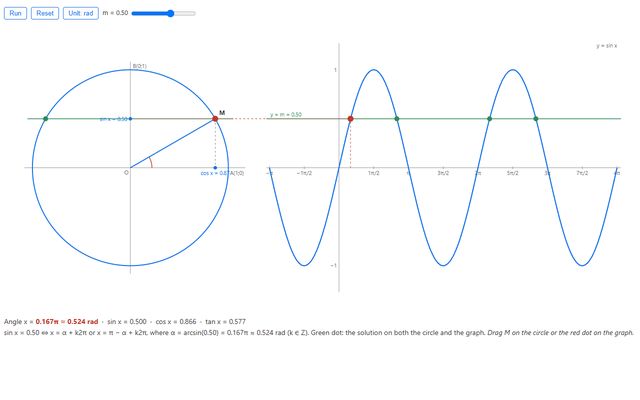 Mathematics · Trigonometry
Unit circle and the sine, cosine, tangent graphs
Mathematics · Trigonometry
Unit circle and the sine, cosine, tangent graphs
-
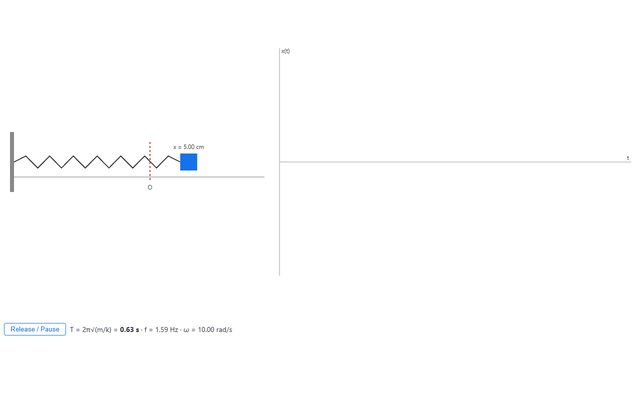 Physics · Oscillations & Waves
Spring pendulum – simple harmonic motion
Physics · Oscillations & Waves
Spring pendulum – simple harmonic motion
-
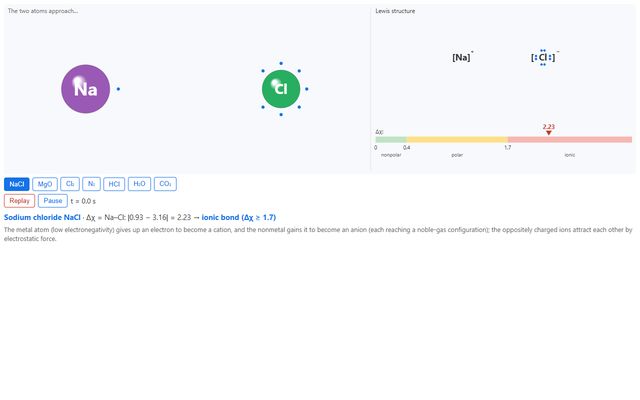 Chemistry · Chemical Bonding
Ionic vs covalent bonding – atomic models (NaCl, MgO, Cl₂, HCl, H₂O, CO₂, N₂)
Chemistry · Chemical Bonding
Ionic vs covalent bonding – atomic models (NaCl, MgO, Cl₂, HCl, H₂O, CO₂, N₂)
-
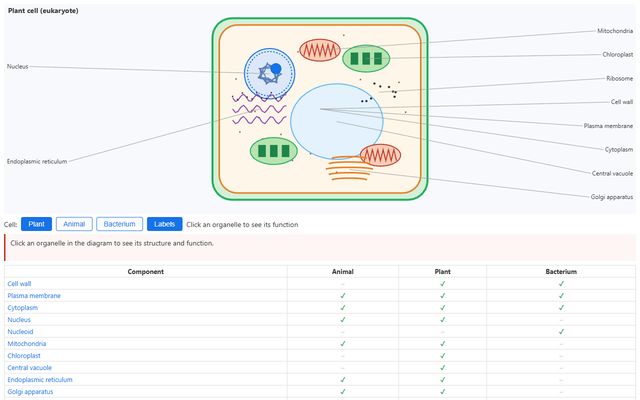 Biology · Cell Biology
Eukaryotic and prokaryotic cell structure
Biology · Cell Biology
Eukaryotic and prokaryotic cell structure
-
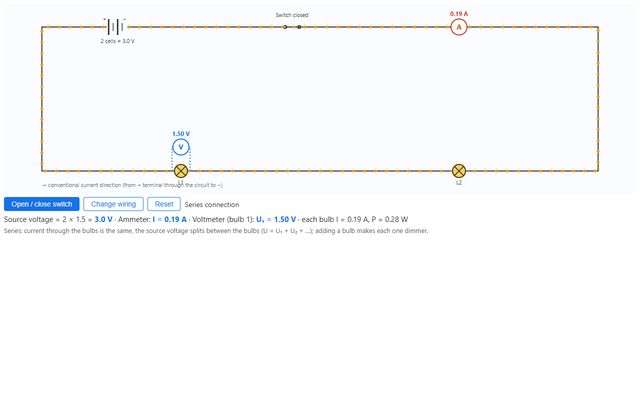 Integrated Science · Electricity & Magnetism
Simple electric circuit – measuring current and voltage
Integrated Science · Electricity & Magnetism
Simple electric circuit – measuring current and voltage
-
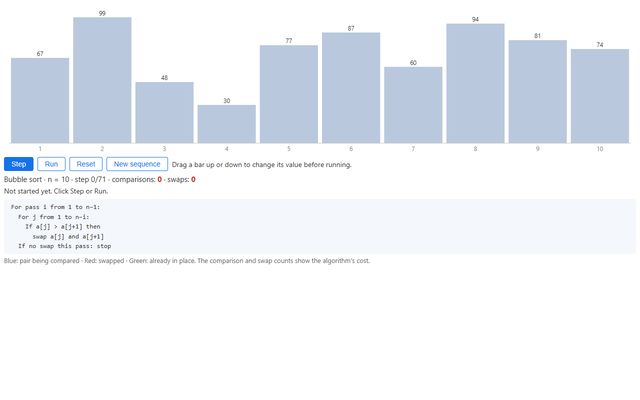 Computer Science · Algorithms & Problem Solving
Visual sorting: bubble, selection and insertion step by step
Computer Science · Algorithms & Problem Solving
Visual sorting: bubble, selection and insertion step by step
-
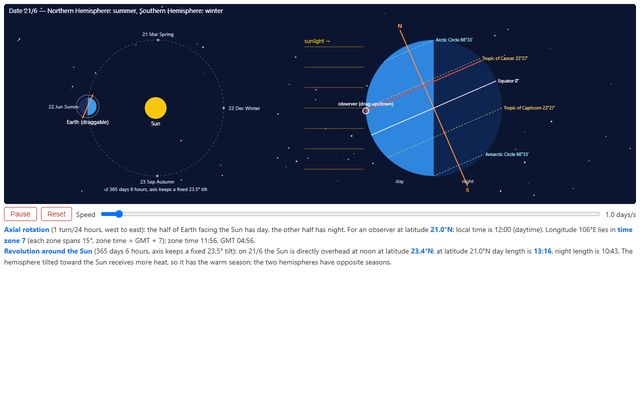 Geography · Earth in Space
Earth's Motion – Day, Night, Time Zones and Seasons
Geography · Earth in Space
Earth's Motion – Day, Night, Time Zones and Seasons
-
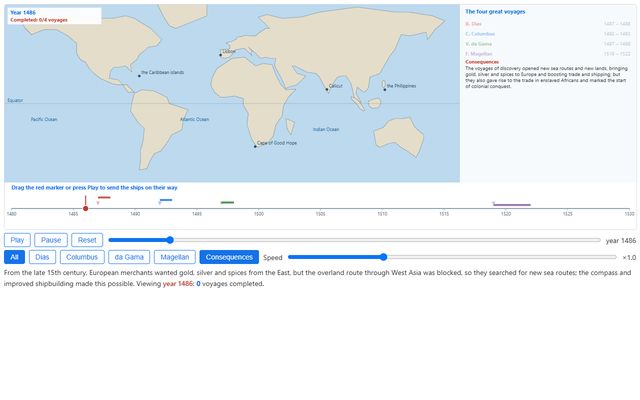 History · Ancient & Medieval World
The Age of Exploration – four great voyages
History · Ancient & Medieval World
The Age of Exploration – four great voyages
-
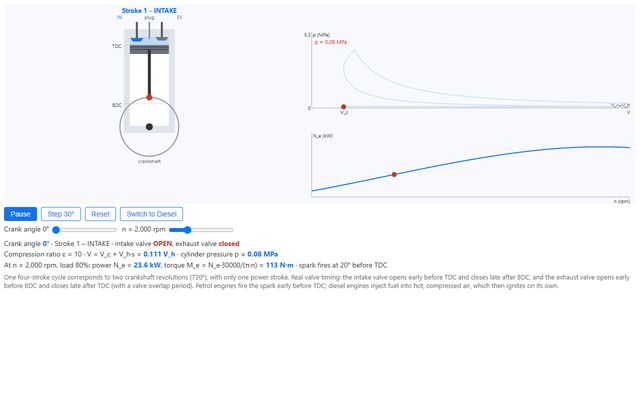 Design & Technology · Mechanical Engineering
Four-stroke internal combustion engine – valves, ignition and the work diagram
Design & Technology · Mechanical Engineering
Four-stroke internal combustion engine – valves, ignition and the work diagram
Create your own interactive simulations
Describe your lesson in plain words and AI builds a working simulation for you, in your language. Or remix any simulation in the library to fit your class.
- Create from a description of your lesson
- Remix any simulation: change the numbers, context or labels
- Share it with your students like any other simulation
New accounts get free credits to try it.
How it works
- 1
Pick a simulation
Find one by subject or topic and set the parameters for your lesson.
- 2
Share a link or QR code
Project it in class, post it to Google Classroom or Teams, or embed it in your website or LMS.
- 3
Students just open it
No accounts, no apps, no student data. It runs in any browser, phones included.